soCash (Review)

[Updated: Oct 2019]

There’s a(n) new app in the App Store – soCash.

Here’s a rough summary of a user experience.

[Before]

1. Upon downloading the app, you can choose to link it to your Facebook(/Google) account or simply provide your email address to sign up.

2. Upon signing up, you can choose either of the funds transfer options:
(a) DBS PayLah!
(b) DBS/POSB iBanking
(c) ICBC

Pretty much whatever you need to do before making your very first cash withdrawal.

[During]

1. Open the app and choose the amount you wish to withdraw. (Minimum $10 and maximum $500 $200)

2. Ensure your current location is accurate to find the nearest cashpoints. (Cashpoints listing would differ based on the amount of money you choose to withdraw. Some cashpoints require you to make a purchase* before you can withdraw money.)

3. Select cashpoint.

4. Confirm cashpoint (and make your way there).

5. Scan QR code on the soCash device (based on your number code) at the cashpoint.

5. Log in to DBS/POSB iBanking portal with your username and pin.

7. Receive the following SMS:
“Your FAST payment via iBanking for S$(amount you chose) to A/C No: XXXXXX1234 on 03/05/2018 is being processed. 12:39:39”

6. A code will appear and you just have to match it with the code that appeared on the little machine in the shop. E.g. 042

7. Once everything is processed and payment is successful, the soCash device will announce for the cashier to pass you your cash the cashier will pass you your cash.

Done.

[After]

(Disadvantages)
1. The process of logging into the bank portal took too long, the cashier managed to clear two customers while I was waiting for my payment to be processed which may result in a certain extent of awkwardness for soCash users.
(Suggestion: to enable user to do a one-time log-in to bank portal and activate fingerprint to approve transaction thereafter.)
–> Users are allowed to log in their bank accounts before reaching the shop. At least, we can save the embarrassment of standing in front of the cashier.

2. The announcement of successful payment by the soCash device is a little too loud (and a little embarrassing) for both cashpoint assistant and soCash users.
(Suggestion: A simple loud “beep” may be sufficient.)
–> The device has finally kept quiet 🙂

3. The email to collect user experience upon using the app can be sent after they made their first transaction. (My first transaction was about 5 days after signing up as the nearest cashpoint was 1km away from me then.)

4. Perhaps my phone is getting old, the app hanged after cash withdrawal.
–> The app has become more user-friendly 🙂

(Advantages)
1. Finally get to know the names of the shops I frequently walked past. (A by-product of using the app)

2. Having users to visiting the cashpoints may also help these shops to increase sales. This is how soCash attracts retailers to sign up as cashpoints.
–> And now that some shops require you to make a purchase in order to withdraw money, it’s definitely a boon than a bane to link up with soCash.

3. Great that I do not have to queue at the ATM. However, assuming that there are long queues at the ATMs only during peak hours, would these shops which serve as cashpoints have a much smaller crowd during peak hours? Would the crowd and long processing time discourage users from using the app to withdraw and just return to queuing in front of the ATMs? Guess as long as there are more cashpoints and a reduction in processing time, this app will still remain convenient and great.

4. Especially convenient and a life-saver if one cannot find an ATM nearby (provided that the nearest cashpoint is nearer than the nearest ATM).

5. They have recently (Oct 2019) brought new deals to users! Before withdrawing your cash, you can pick a deal among the many they have listed. Some examples are:
a) $15 off Agoda booking
b) 10% off Sephora if you are a new customer
c) $5 off GrabFood with $30 spent
d) and many more…(please read the T&Cs of each promotion carefully)
Personally think that this is a real good way of attracting new users and bringing back old customers 🙂

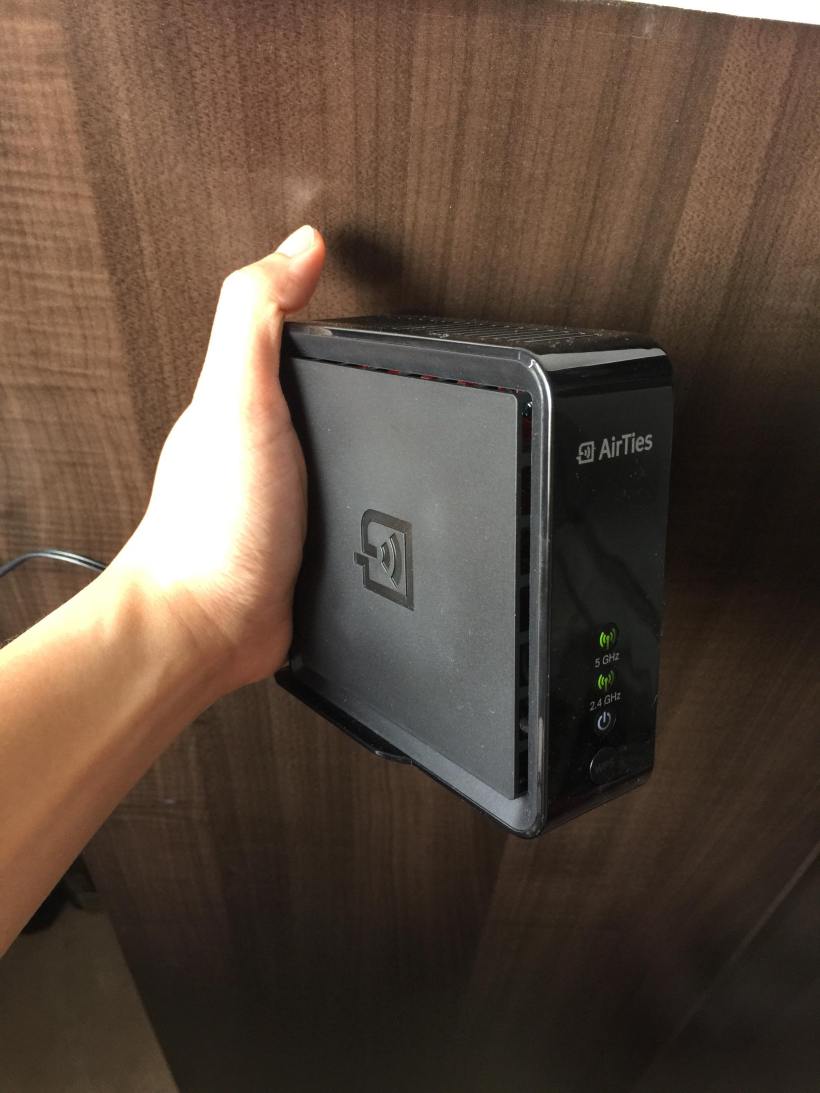
Singtel WiFi Mesh (AirTies: 1600 Mbps Wireless Booster Air 4920)

The journey of getting a pair of WiFi Mesh.

Re-contracted with Singtel 1Gbps Fibre Home Bundle (24 mths). Upon using it for close to a month, we could not take the frequent disconnection at the various dead spots/corners. Therefore, we decided to purchase a pair of AirTies Air 4920 units (also known as WiFi Mesh) at the cost of SGD10 per month (24 mths).

Adding on the two AirTies units on top of the Singtel Fibre contract isn’t too difficult. You just need to spend one to two hours queuing at any Singtel stores. Get a queue ticket and walk around the mall. You can opt for SMS notification when the queue is approaching your number.

In the box, which you will receive upon subscription,you will see two AirTies units, 2 Ethernet cables, and two power adapters. On top of these, you will see a Quick Installation Guide.

The Quick Installation Guide is too ‘quick’ and not idiot proof enough. So here’s the Dummy’s Guide!

AirTies for Dummies

1. Remove the transparent plastic sheet that is covering both AirTies. (If not the units will get too hot and melt the plastic, one day.)

2. Connect the power adapters to both units and insert them into a power point (plug) near your Singtel Optical Network Terminal.

3. Connect one of the units to the Singtel WiFi Router with the Ethernet cable.

4. Turn on both units. (You will see white light on both units, it means they are being switched on.)

5. After a few minutes, you will see green lights flashing for both 2.4GHz led and 5GHz led.

6. To check if the internet connection is working, connect any mobile device to the new wireless network (please refer to the bottom of the AirTies units for network name and password. Network name and password are the same for both units).

7. Once connected to the new wireless network, you may unplug the unit which is not connected with Ethernet cable and relocate it to somewhere else at your home. (Most likely a location with dead spot as that is the purpose of you purchasing the AirTies.) Remember to switch the unit on after relocation.

8. Now, when the new network connection is working perfectly fine, you may choose to customize your network by changing its network name and password. With any device that is connected to the new network connection, visit http://ez.airtiesmesh.com . Default username is “admin” and leave the password field blank. On successful login, you may unleash your creativity and give your new network a wonderful name.

What happens to the other unit? Yes, it would have to be within 1.5m from the Singtel WiFi Router as it has to be connected to the router with the Ethernet cable.

Hence, if your house is large with many dead spots, it would be recommended to purchase one more unit. However, for normal HDB flats, two units would most likely be sufficient.

FYI, Page 5 of the Quick Installation Guide is pretty useful.

To add more unit(s), besides reading the Quick Installation Guide, you may wish to watch this YouTube video as well:

Recycling in Singapore

Where to Recycle in Singapore?

There are more than 8000 recycling bins in residential estates all over Singapore[1].

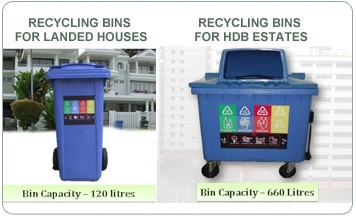
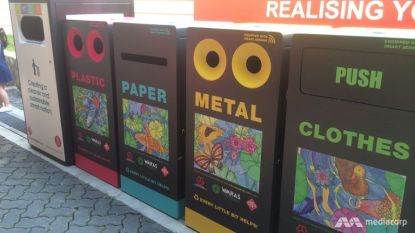
Below are the various types of Recycling Bins that you may see:

Figure 1 Recycling Bins for landed houses & HDB estates
 Figure 1 Recycling Bins for landed houses & HDB estates
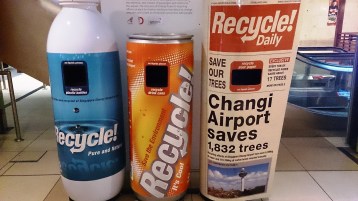
Figure 2 Recycling Bins at Singapore Changi Airport
 Figure 2 Recycling Bins at Singapore Changi Airport
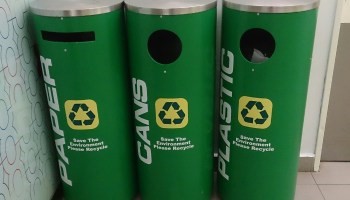
Figure 3 Recycling Bins at Shopping Malls
 Figure 3 Recycling Bins at Shopping Malls
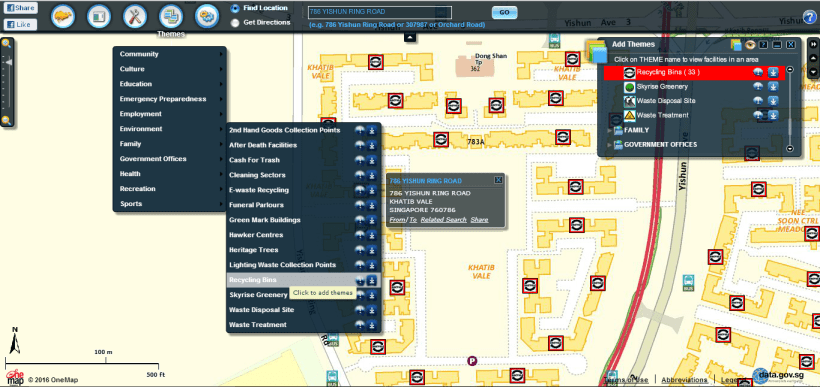
You may finding the nearest Recycling Bin via this website:
http://www.onemap.sg

OneMap
Figure 4 Screenshot of SLA OneMap.sg
Clicking Steps:
  Themes>Environment>Recycling Bins

There are other services which you may be interested in exploring on this website, e.g. 2nd Hand Goods Collection Points, Cash for Trash and Green Mark Building.

Smart Bins at Hong Kah Community Club

Figure 5 Smart Bins at Hong Kah CC
 Figure 5 Smart Bins at Hong Kah Community Club

The newly introduced and attractive Smart Bins were placed at the Hong Kah Community Club in December 2015 to promote the habit of recycling[2].

Hopefully, these Smart Bins can be widely introduced across the island to further encourage Singaporeans to recycle.

– – –

What to Recycle in Singapore?

There are 5 main categories that recyclable items are usually classified under, (1) Paper, (2) Plastics, (3) Metal, (4) Glass and (5) Others.

You may press Ctrl+F to find if certain items are recyclable.

(1) Paper (纸)

Most papers are recyclable. Below are some examples (list is non-exhaustive) which you can place into the recycling bins in Singapore [3].

  • Red Packets (Ang Bao, Hong Bao, 红包)
  • Envelopes (信封)
  • Cardboard tubes for paper towels (Toilet paper tube, 纸筒)
  • Brochures (Flyers, pamphlets, 宣传纸, 宣传册)
    [Both glossy and non-glossy. 无论是否用光纸印的。]
  • Shredded papers (碎纸)
  • Any box (Cereal box, biscuit box, 纸皮箱, 纸盒)
    [Flatten if possible. 尽可折叠。]
  • Drink pack/carton (饮料包装)
    [Empty it, rinse and flatten if possible. 清空、并尽可清洗与折平。]
  • Yellow Pages
  • Stamps (邮票)
  • Namecards (名片)
  • Newspapers (报纸)
  • Magazines (Newsletters, 杂志)
  • Books (书)
  • Corrugated cardboard (瓦楞纸板)

(2) Plastics (塑料)

Usually, we would think that all plastics are recyclable but Styrofoam is a big NO.
Many would take a look at the number being surrounded by 3 arrows, which form a triangle, and try to determine whether that particular piece of plastic can be recycled – Resin Identification Code (RIC).

We need to understand that the RIC DOES NOT TELL US THE RECYCLABILITY OF THE PLASTIC, it only communicates the unique properties of the plastic [4].

1. PET (Polyethylene terephthalate) – Used for water bottles, soft drink and cooking oil bottles, and meal trays.

2. HDPE (High density polyethylene) – Used for milk and detergent bottles.

3. PVC (Polyvinyl chloride) – Used for plastic pipes, food trays, shrink wrap, and bottles.

4. LDPE (Low density polyethylene) – Used for plastic bags and bin liners.

5. PP (Polypropylene) – Used for bottle caps, margarine tubs, and meal trays.

6. PS (Polystyrene) – Used for food containers, egg cartons, vending cups, plastic cutlery, and protective packaging for electronic goods.

7. OTHER – Includes any other plastic that does not fall into the above categories.

All type 1 and 2 can be recycled. For plastics with RIC above 2, you might want to check against the list below provided by ZeroWasteSG:

  • Plastic drink bottle / container
  • Bread wrapper & tag
  • Plastic bag / packaging
  • Plastic packaging for biscuit / beverage packets
  • Facial foam plastic tube
  • CD & casing
  • Plastic cutlery
  • Yakult / Vitagen / yogurt bottle
  • Plastic cup / container
  • Straw
  • Cleaner / shampoo bottle
  • Cassette /video tape

(3) Metal (金属)

There are two types of metal, ferrous metal which are magnetic (e.g. iron & steel) and non-ferrous metal which are non-magnetic (e.g. stainless steel, aluminium, copper & bronze.

Ferrous metal are usually recycled in local steel mill while non-ferrous metal are transported overseas for recycling.

The common types of metal scrap in Singapore are [5]:

  • Steel (drink cans, aerosol cans, food containers, bars, beams, wires, pipes, chains, electrical goods, cars, etc)
  • Stainless steel (clippings, sheets, turnings, etc)
  • Aluminium (drink cans, clippings and turnings, windows and door frames, aluminium casting and sheet, etc)
  • Copper (copper wires, strips, etc)

(4) Glass (玻璃)

Recycled glass are usually sorted into clear, brown and green, and exported overseas as there is no glass recycling plant in Singapore [6].

Examples of glass that can be recycled:

  • Beer / wine bottle
  • Glass container
  • Glass cups
  • Wine glasses

(5) Others (其它)

YOU CAN RECYCLE YOUR CLOTHES TOO!

– – –

[1] ZeroWasteSG (http://www.zerowastesg.com/2009/02/13/where-can-i-find-recycling-bins/)

[2] The Straits Times: Hong Kah North rolls out smart bins in green campaign (http://www.straitstimes.com/singapore/environment/hong-kah-north-rolls-out-smart-bins-in-green-campaign)

[3] ZeroWasteSG: Can Recycle? (http://www.zerowastesg.com/can-recycle/)

[4] Earth911: Frequent Plastic Jug & Bottle Recycling Questions (http://www.earth911.com/recycling-guide/how-to-recycle-plastic-jugs-bottles/)

[5] ZeroWasteSG: Metal Recycling (http://www.zerowastesg.com/2008/12/08/metal-recycling/)

[6] ZeroWasteSG: Glass Recycling (http://www.zerowastesg.com/2008/12/08/glass-recycling/)

Recycling in Singapore.

Where to Recycle in Singapore?

There are more than 8000 recycling bins in residential estates all over Singapore[1].

Below are the various types of Recycling Bins that you may see:

Figure 1 Recycling Bins for landed houses & HDB estates
 Figure 1 Recycling Bins for landed houses & HDB estates
Figure 2 Recycling Bins at Singapore Changi Airport
 Figure 2 Recycling Bins at Singapore Changi Airport
Figure 3 Recycling Bins at Shopping Malls
 Figure 3 Recycling Bins at Shopping Malls

You may finding the nearest Recycling Bin via this website:
http://www.onemap.sg

OneMap
Figure 4 Screenshot of SLA OneMap.sg
Clicking Steps:
  Themes>Environment>Recycling Bins

There are other services which you may be interested in exploring on this website, e.g. 2nd Hand Goods Collection Points, Cash for Trash and Green Mark Building.

Smart Bins at Hong Kah Community Club

Figure 5 Smart Bins at Hong Kah CC
 Figure 5 Smart Bins at Hong Kah Community Club

The newly introduced and attractive Smart Bins were placed at the Hong Kah Community Club in December 2015 to promote the habit of recycling[2].

Hopefully, these Smart Bins can be widely introduced across the island to further encourage Singaporeans to recycle.

– – –

What to Recycle in Singapore?

There are 5 main categories that recyclable items are usually classified under, (1) Paper, (2) Plastics, (3) Metal, (4) Glass and (5) Others.

You may press Ctrl+F to find if certain items are recyclable.

(1) Paper (纸)

Most papers are recyclable. Below are some examples (list is non-exhaustive) which you can place into the recycling bins in Singapore [3].

  • Red Packets (Ang Bao, Hong Bao, 红包)
  • Envelopes (信封)
  • Cardboard tubes for paper towels (Toilet paper tube, 纸筒)
  • Brochures (Flyers, pamphlets, 宣传纸, 宣传册)
    [Both glossy and non-glossy. 无论是否用光纸印的。]
  • Shredded papers (碎纸)
  • Any box (Cereal box, biscuit box, 纸皮箱, 纸盒)
    [Flatten if possible. 尽可折叠。]
  • Drink pack/carton (饮料包装)
    [Empty it, rinse and flatten if possible. 清空、并尽可清洗与折平。]
  • Yellow Pages
  • Stamps (邮票)
  • Namecards (名片)
  • Newspapers (报纸)
  • Magazines (Newsletters, 杂志)
  • Books (书)
  • Corrugated cardboard (瓦楞纸板)

(2) Plastics (塑料)

Usually, we would think that all plastics are recyclable but Styrofoam is a big NO.
Many would take a look at the number being surrounded by 3 arrows, which form a triangle, and try to determine whether that particular piece of plastic can be recycled – Resin Identification Code (RIC).

We need to understand that the RIC DOES NOT TELL US THE RECYCLABILITY OF THE PLASTIC, it only communicates the unique properties of the plastic [4].

1. PET (Polyethylene terephthalate) – Used for water bottles, soft drink and cooking oil bottles, and meal trays.

2. HDPE (High density polyethylene) – Used for milk and detergent bottles.

3. PVC (Polyvinyl chloride) – Used for plastic pipes, food trays, shrink wrap, and bottles.

4. LDPE (Low density polyethylene) – Used for plastic bags and bin liners.

5. PP (Polypropylene) – Used for bottle caps, margarine tubs, and meal trays.

6. PS (Polystyrene) – Used for food containers, egg cartons, vending cups, plastic cutlery, and protective packaging for electronic goods.

7. OTHER – Includes any other plastic that does not fall into the above categories.

All type 1 and 2 can be recycled. For plastics with RIC above 2, you might want to check against the list below provided by ZeroWasteSG:

  • Plastic drink bottle / container
  • Bread wrapper & tag
  • Plastic bag / packaging
  • Plastic packaging for biscuit / beverage packets
  • Facial foam plastic tube
  • CD & casing
  • Plastic cutlery
  • Yakult / Vitagen / yogurt bottle
  • Plastic cup / container
  • Straw
  • Cleaner / shampoo bottle
  • Cassette /video tape

(3) Metal (金属)

There are two types of metal, ferrous metal which are magnetic (e.g. iron & steel) and non-ferrous metal which are non-magnetic (e.g. stainless steel, aluminium, copper & bronze.

Ferrous metal are usually recycled in local steel mill while non-ferrous metal are transported overseas for recycling.

The common types of metal scrap in Singapore are [5]:

  • Steel (drink cans, aerosol cans, food containers, bars, beams, wires, pipes, chains, electrical goods, cars, etc)
  • Stainless steel (clippings, sheets, turnings, etc)
  • Aluminium (drink cans, clippings and turnings, windows and door frames, aluminium casting and sheet, etc)
  • Copper (copper wires, strips, etc)

(4) Glass (玻璃)

Recycled glass are usually sorted into clear, brown and green, and exported overseas as there is no glass recycling plant in Singapore [6].

Examples of glass that can be recycled:

  • Beer / wine bottle
  • Glass container
  • Glass cups
  • Wine glasses

(5) Others (其它)

YOU CAN RECYCLE YOUR CLOTHES TOO!

– – –

[1] ZeroWasteSG (http://www.zerowastesg.com/2009/02/13/where-can-i-find-recycling-bins/)

[2] The Straits Times: Hong Kah North rolls out smart bins in green campaign (http://www.straitstimes.com/singapore/environment/hong-kah-north-rolls-out-smart-bins-in-green-campaign)

[3] ZeroWasteSG: Can Recycle? (http://www.zerowastesg.com/can-recycle/)

[4] Earth911: Frequent Plastic Jug & Bottle Recycling Questions (http://www.earth911.com/recycling-guide/how-to-recycle-plastic-jugs-bottles/)

[5] ZeroWasteSG: Metal Recycling (http://www.zerowastesg.com/2008/12/08/metal-recycling/)

[6] ZeroWasteSG: Glass Recycling (http://www.zerowastesg.com/2008/12/08/glass-recycling/)